Animal · Germany, United Kingdom, France
European hedgehog
Erinaceus europaeus — the name this animal has in the language scientists everywhere share.
The European hedgehog is a small, spiny mammal that curls into a tight ball when threatened. It roams gardens, hedgerows and woodlands across Europe at night, hunting insects.
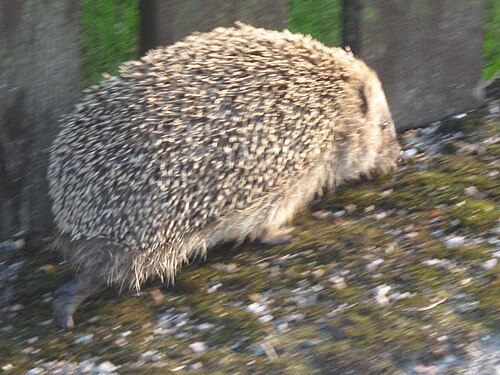
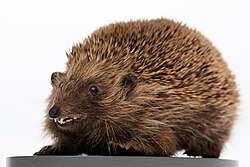
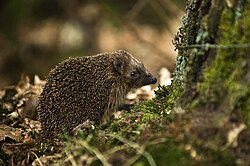
Picture credit: Gegik (CC BY-SA 3.0) · Auckland Museum Collections (CC BY 2.0) · Hrald (CC BY-SA 3.0) · Wikimedia Commons
Where does the european hedgehog live?
Home: Gardens, hedgerows and woodlands across Europe.
In the wild you find it in: Germany, United Kingdom, France, Italy, Netherlands, Switzerland, Poland, Sweden.
Conservation status from the IUCN: close to being at risk.
The short profile
Fully grown it measures up to 27 cm long. It weighs about 0.8 kilograms. On the menu: insects.
The story behind it
A hedgehog has around 5,000 to 7,000 hollow spines covering its back, made of the same material as hair, and can roll into a nearly perfect ball using a special muscle that pulls its skin tight like a drawstring bag. In autumn it eats as much as possible to build up fat before spending the coldest months in a state of hibernation, during which its body temperature drops close to the surrounding air. Hedgehogs can walk several kilometres in a single night searching for slugs, beetles and worms, making large gardens and connected green spaces important for them. Falling numbers due to habitat loss, busy roads and fewer insects have made this once-common garden visitor near threatened in several countries.
Find it on the globe
European hedgehog is there as a tiny animated figure that breathes and looks around. From far away the planet is only a blue ball; detail arrives as you zoom in, and this one appears once you are close enough. Open it on the globe.
It sits at its real coordinates, not near them — the same numbers listed in the facts above. Switch off the layer for this kind of place and it disappears again; the buttons for that are down the right-hand edge.
Questions children ask
How does a hedgehog roll into a ball?
A hedgehog has a special ring-shaped muscle running along its sides that tightens like a drawstring, pulling its spiny skin over its head and legs into a tight, protective ball when it senses danger.
Do hedgehogs really hibernate?
Yes, European hedgehogs hibernate through the coldest months, usually from around November to March, with their heart rate and body temperature dropping dramatically to save energy when food is scarce.
Why are hedgehogs disappearing from gardens?
Hedgehog numbers are falling mainly because fences and walled gardens block their nightly roaming routes, roads cause many deaths, and fewer insects mean less food. Leaving small gaps in garden fences can help them move safely between gardens.
Where these numbers come from
Every figure on this page was checked against public reference sources before publication. Where sources genuinely disagree, the text says so.
Last checked: