Animal · United States, Canada, Russia
Grey wolf
Canis lupus — the name this animal has in the language scientists everywhere share.
The grey wolf is the ancestor of all pet dogs and one of the most widespread wild predators, once ranging across most of the Northern Hemisphere. It lives and hunts in tight-knit family packs.
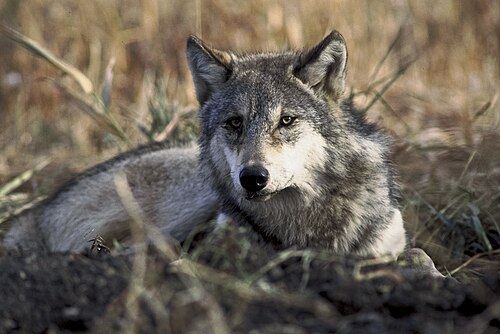
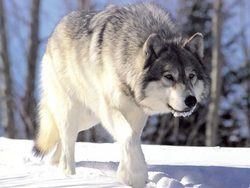
Picture credit: John and Karen Hollingsworth (Public domain) · Jim Peaco for NPS (Public domain) · Chris Muiden (CC BY-SA 3.0) · Wikimedia Commons
Where does the grey wolf live?
Home: Forests, tundra and mountains across the Northern Hemisphere.
In the wild you find it in: United States, Canada, Russia, Mongolia, China, Poland, Romania, Germany.
Conservation status from the IUCN: not in danger.
The short profile
Fully grown it measures up to 1.6 m long, plus a 0.5 m tail. It weighs about 40 kilograms. On the menu: meat.
The story behind it
A wolf pack is really a family, usually led by a breeding pair, with older pups helping raise younger siblings, much like a big human family. Wolves can travel over 50 km in a single day searching for food and communicate across long distances by howling, which helps pack members find each other and warns rival wolves to stay away. Their sense of smell is around 100 times more sensitive than a human's. Wolves were hunted to extinction across much of Europe and America in past centuries because farmers feared for their livestock, but successful reintroduction projects, such as in Yellowstone, have helped populations recover in several regions.
Find it on the globe
Grey wolf is there as a tiny animated figure that breathes and looks around. From far away the planet is only a blue ball; detail arrives as you zoom in, and this one appears once you are close enough. Open it on the globe.
It sits at its real coordinates, not near them — the same numbers listed in the facts above. Switch off the layer for this kind of place and it disappears again; the buttons for that are down the right-hand edge.
Questions children ask
Why do wolves howl?
Wolves howl to communicate over long distances, helping pack members locate each other, gather the group, and warn rival wolf packs to stay out of their territory. Howls can carry for several kilometres.
Are wolves dangerous to humans?
Healthy wild wolves are naturally wary of humans and attacks on people are extremely rare. Wolves generally avoid people and prefer to hunt wild prey like deer and elk instead.
Are dogs related to wolves?
Yes, all domestic dogs descend from grey wolves that were tamed by humans thousands of years ago. This is why dogs still share many wolf behaviours, like howling, pack instincts, and body language.
Where these numbers come from
Every figure on this page was checked against public reference sources before publication. Where sources genuinely disagree, the text says so.
Last checked: