Animal · Bahamas, United States, Australia
Great hammerhead shark
Sphyrna mokarran — the name this animal has in the language scientists everywhere share.
The great hammerhead shark is instantly recognisable by its wide, flattened head shaped like a hammer, called a cephalofoil. It hunts in warm coastal and offshore waters around the world.
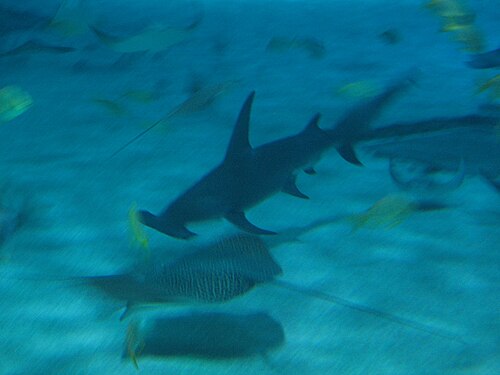

Picture credit: James Emery (CC BY 2.0) · Florida Keys--Public Libraries (CC BY 2.0) · Wikimedia Commons
Where does the great hammerhead shark live?
Home: Warm coastal and offshore waters worldwide.
In the wild you find it in: Bahamas, United States, Australia, South Africa, Mexico.
Conservation status from the IUCN: critically endangered.
The short profile
Fully grown it measures Up to 4.6 m long. It weighs about 230 kilograms. On the menu: meat.
The story behind it
A hammerhead's oddly shaped head is packed with electrical sensors spread wide across its width, giving it an unusually broad field of detection for finding prey buried in the sand, especially its favourite food, stingrays. The shape also acts like a wing, giving the shark extra lift and helping it turn sharply while hunting. Great hammerheads have even been filmed pinning stingrays to the seafloor with their head before eating them, apparently unbothered by the ray's venomous barb. Unlike many sharks, hammerheads often swim in large groups called schools, sometimes numbering in the hundreds, though adults tend to hunt alone at night. Heavily targeted for their large fins, great hammerhead numbers have collapsed by more than 80 percent in recent decades, making them critically endangered.
Find it on the globe
Great hammerhead shark is there as a tiny animated figure that breathes and looks around. From far away the planet is only a blue ball; detail arrives as you zoom in, and this one appears once you are close enough. Open it on the globe.
It sits at its real coordinates, not near them — the same numbers listed in the facts above. Switch off the layer for this kind of place and it disappears again; the buttons for that are down the right-hand edge.
Questions children ask
Why does a hammerhead shark have such a strange head?
A hammerhead's wide, flat head spreads out its electrical sensors, letting it scan a much larger area of sand for hidden prey like stingrays. The shape also improves its lift and helps it turn sharply while swimming.
Do hammerhead sharks eat stingrays?
Yes, stingrays are a favourite food of great hammerhead sharks, which pin the rays to the seafloor with their head before eating them. They seem largely unaffected by a stingray's venomous barb.
Why are great hammerhead sharks critically endangered?
Great hammerhead sharks are critically endangered mainly because they are heavily fished for their large, valuable fins, used in shark fin soup. Because they reproduce slowly, populations have collapsed and struggle to recover.
Where these numbers come from
Every figure on this page was checked against public reference sources before publication. Where sources genuinely disagree, the text says so.
Last checked: