Animal · Norway, United Kingdom, Germany
Moon jellyfish
Aurelia aurita — the name this animal has in the language scientists everywhere share.
The moon jelly is one of the most common jellyfish in the world, drifting through coastal seas on every continent. Its almost see-through bell makes it easy to recognise.
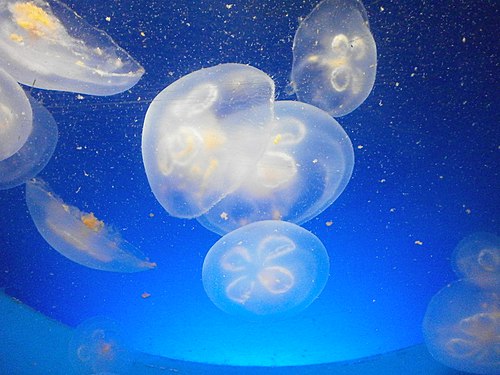
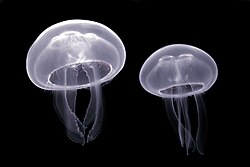
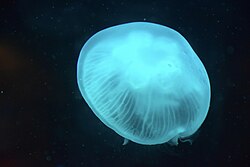
Picture credit: Gip3798 (CC BY-SA 4.0) · Luc Viatour (CC BY-SA 3.0) · Ank Kumar (CC BY-SA 4.0) · Wikimedia Commons
Where does the moon jellyfish live?
Home: Coastal seas worldwide, from the tropics to cooler waters.
In the wild you find it in: Norway, United Kingdom, Germany, United States, Japan, Australia.
The short profile
Fully grown it measures 25–40 cm across. On the menu: meat.
The story behind it
A moon jelly has no brain, no heart and no blood, yet it has survived for hundreds of millions of years, making jellyfish some of the oldest animals on the planet, older even than the dinosaurs. It moves by pulsing its bell-shaped body, but mostly drifts wherever ocean currents carry it, sometimes gathering in huge groups called blooms that can stretch for kilometres. Moon jellies catch tiny plankton using short, gentle tentacles around the edge of their bell, and their sting is generally too mild to bother most people, unlike some more dangerous jellyfish species. Four horseshoe-shaped organs visible through its transparent body are its gonads, used for reproduction. Because moon jellies are so widespread and adaptable, and have not been formally assessed by conservation scientists, their global population trend is not officially tracked.
Find it on the globe
Moon jellyfish is there as a tiny animated figure that breathes and looks around. From far away the planet is only a blue ball; detail arrives as you zoom in, and this one appears once you are close enough. Open it on the globe.
It sits at its real coordinates, not near them — the same numbers listed in the facts above. Switch off the layer for this kind of place and it disappears again; the buttons for that are down the right-hand edge.
Questions children ask
Are moon jellyfish dangerous?
No, moon jellyfish have a very mild sting that most people barely feel, unlike some other jellyfish species. They catch tiny plankton with short tentacles, which are not strong enough to seriously harm a human.
How do jellyfish move without a brain?
Jellyfish have no brain, but a simple network of nerves lets them pulse their bell-shaped body to swim gently. Most of their movement, though, comes from drifting wherever ocean currents happen to carry them.
How old are jellyfish as a species?
Jellyfish have existed for hundreds of millions of years, making them older than dinosaurs and one of the oldest animal groups still alive today. Fossils of jellyfish-like creatures date back over 500 million years.
Where these numbers come from
Every figure on this page was checked against public reference sources before publication. Where sources genuinely disagree, the text says so.
Last checked: