Animal · Germany, United Kingdom, France
Common kingfisher
Alcedo atthis — the name this animal has in the language scientists everywhere share.
The common kingfisher is a small, jewel-coloured bird with brilliant blue and orange feathers, often seen as a flash of colour along rivers and streams. It hunts fish across Europe, Asia and North Africa.
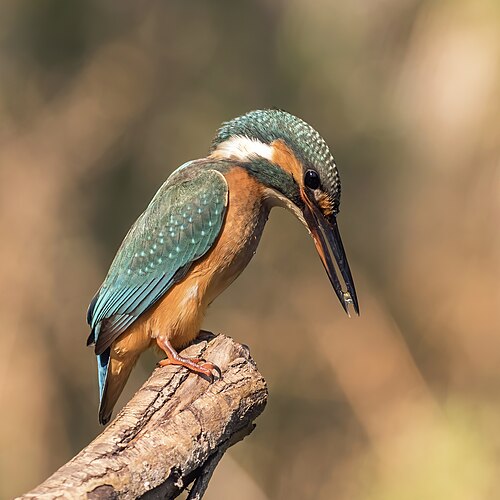
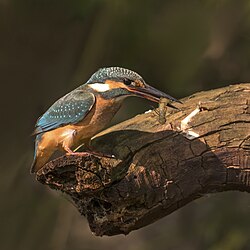
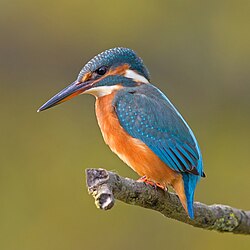
Picture credit: Charles J. Sharp (CC BY-SA 4.0) · Charles J. Sharp (CC BY-SA 4.0) · Andreas Trepte (CC BY-SA 2.5) · Wikimedia Commons
Where does the common kingfisher live?
Home: Rivers, streams and lakes across Europe, Asia and North Africa.
In the wild you find it in: Germany, United Kingdom, France, India, China.
Conservation status from the IUCN: not in danger.
The short profile
Fully grown it measures 16–17 cm long. It weighs about 0.04 kilograms. On the menu: meat.
The story behind it
A common kingfisher hunts by watching the water from a perch or hovering in place, then diving headfirst into the water at high speed to grab a fish, closing special membranes over its eyes at the moment of impact to protect them. It can dive from a perch and strike a fish in less than a second, one of the fastest hunting moves of any bird. Kingfishers dig nesting tunnels up to a metre long into riverbanks, where the female lays her eggs on a bed of regurgitated fish bones. A hungry chick can eat several small fish a day, and parents make dozens of fishing trips daily to feed a growing brood. Clean, unpolluted rivers are essential for kingfishers, so their presence is often a sign of healthy water.
Find it on the globe
Common kingfisher is there as a tiny animated figure that breathes and looks around. From far away the planet is only a blue ball; detail arrives as you zoom in, and this one appears once you are close enough. Open it on the globe.
It sits at its real coordinates, not near them — the same numbers listed in the facts above. Switch off the layer for this kind of place and it disappears again; the buttons for that are down the right-hand edge.
Questions children ask
How does a kingfisher catch fish?
A kingfisher watches the water from a perch or hovers above it, then dives headfirst at high speed to grab a fish in its beak. Special eye membranes protect it from the impact of hitting the water.
Where do kingfishers nest?
Kingfishers dig a nesting tunnel, sometimes up to a metre long, straight into a riverbank using their beak and feet. The female lays her eggs at the end of the tunnel on a bed of fish bones.
Is seeing a kingfisher a good sign?
Yes, kingfishers need clean, healthy rivers full of small fish to survive, so spotting one is often a good sign that the water is not badly polluted. Their presence is sometimes used to judge river health.
Where these numbers come from
Every figure on this page was checked against public reference sources before publication. Where sources genuinely disagree, the text says so.
Last checked: