Animal · Indonesia
Komodo dragon
Varanus komodoensis — the name this animal has in the language scientists everywhere share.
The Komodo dragon is the largest lizard alive today, growing up to 3 metres long and hunting animals as large as water buffalo. It lives only on a handful of Indonesian islands.
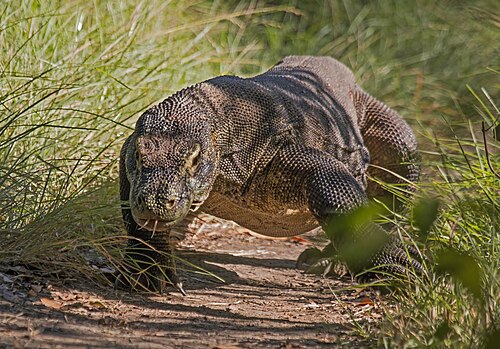
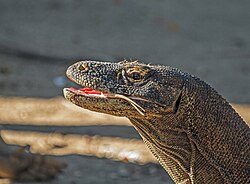
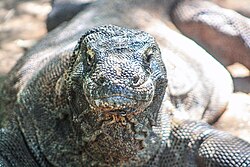
Picture credit: Charles J. Sharp (CC BY-SA 4.0) · Charles J. Sharp (CC BY-SA 4.0) · Alibasdaysar (CC BY-SA 4.0) · Wikimedia Commons
Where does the komodo dragon live?
Home: The islands of Komodo, Rinca and Flores in Indonesia.
In the wild you find it in: Indonesia.
Conservation status from the IUCN: endangered.
The short profile
Fully grown it measures Up to 3 m long. It weighs about 70 kilograms. On the menu: meat.
The story behind it
Komodo dragons hunt using a combination of stealth and a bite loaded with venom glands, discovered only in 2009, which prevent a wound from clotting and cause the prey's blood pressure to drop, weakening the animal over time even if it escapes the initial attack. Dragons then use their extraordinary sense of smell, detected mainly with their forked tongue, to track wounded prey for kilometres, sometimes over several days, before it finally collapses. A Komodo dragon can eat up to 80 percent of its own body weight in a single meal and can survive on just a handful of large meals each year. Females can occasionally reproduce without a male through a rare process called parthenogenesis. Because they exist only on a few small islands, Komodo dragons are highly vulnerable to habitat loss and rising sea levels, and are now classed as endangered.
Find it on the globe
Komodo dragon is there as a tiny animated figure that breathes and looks around. From far away the planet is only a blue ball; detail arrives as you zoom in, and this one appears once you are close enough. Open it on the globe.
It sits at its real coordinates, not near them — the same numbers listed in the facts above. Switch off the layer for this kind of place and it disappears again; the buttons for that are down the right-hand edge.
Questions children ask
Are Komodo dragons venomous?
Yes, Komodo dragons have venom glands in their lower jaw, discovered by scientists in 2009. Their venom stops blood from clotting and lowers blood pressure, helping to weaken large prey even after the initial bite.
Can Komodo dragons reproduce without a mate?
In rare cases, yes. Female Komodo dragons can occasionally produce offspring without mating, through a process called parthenogenesis, though this happens far less often than normal reproduction with a male.
Why are Komodo dragons endangered?
Komodo dragons live only on a few small Indonesian islands, so habitat loss, rising sea levels and human encroachment can seriously threaten their small, isolated population, which is why they were reclassified as endangered in 2021.
Where these numbers come from
Every figure on this page was checked against public reference sources before publication. Where sources genuinely disagree, the text says so.
Last checked: