Animal · United States, Canada, Russia
Moose
Alces alces — the name this animal has in the language scientists everywhere share.
The moose is the largest species of deer in the world, standing tall in the cold forests and wetlands of the far north. Males grow enormous antlers that can span over 1.5 metres.
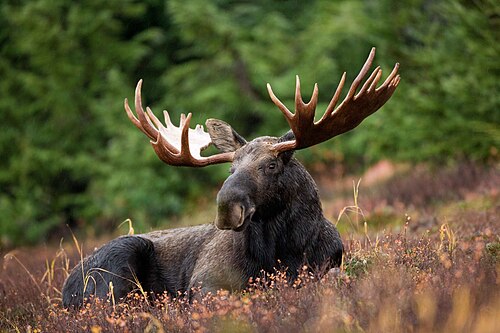
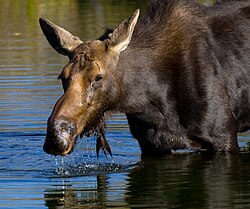
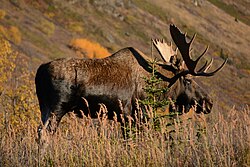
Picture credit: Ryan Hagerty (Public domain) · Tony Hisgett (CC BY 2.0) · Paxson Woelber (CC BY-SA 4.0) · Wikimedia Commons
Where does the moose live?
Home: Boreal forests and wetlands across the far north.
In the wild you find it in: United States, Canada, Russia, Sweden, Norway, Finland, Estonia, Latvia.
Conservation status from the IUCN: not in danger.
The short profile
Fully grown it measures up to 2.1 m tall at the shoulder. It weighs about 450 kilograms. On the menu: plants.
The story behind it
A moose can dive completely underwater to feed on tasty aquatic plants at the bottom of lakes, holding its breath for up to 30 seconds and even closing special flaps in its nose to keep water out. Its long legs let it wade through deep snow and swim strongly across lakes and rivers, sometimes for several kilometres. A bull moose sheds and regrows its huge antlers every single year, growing them from scratch in only about five months, among the fastest bone growth of any animal. Despite their size, moose can run at up to 55 km/h through dense forest. Moose populations remain healthy across most of their range in North America, Scandinavia and Russia.
Find it on the globe
Moose is there as a tiny animated figure that breathes and looks around. From far away the planet is only a blue ball; detail arrives as you zoom in, and this one appears once you are close enough. Open it on the globe.
It sits at its real coordinates, not near them — the same numbers listed in the facts above. Switch off the layer for this kind of place and it disappears again; the buttons for that are down the right-hand edge.
Questions children ask
Can moose swim?
Yes, moose are excellent swimmers and can cross lakes several kilometres wide, even diving completely underwater to reach aquatic plants at the bottom. Their long legs and large lungs make them well suited to water.
How big can a moose's antlers get?
A bull moose's antlers can span over 1.5 metres from tip to tip and weigh over 20 kg, making them the largest antlers of any living deer species. They are shed and regrown completely every year.
Are moose dangerous?
Moose are usually calm but can become dangerous if surprised, cornered, or during the autumn mating season when bulls are more aggressive, or when a mother is protecting her calf. Keeping a safe distance is always wise.
Where these numbers come from
Every figure on this page was checked against public reference sources before publication. Where sources genuinely disagree, the text says so.
Last checked: