Animal · Iceland, Norway, United Kingdom
Atlantic puffin
Fratercula arctica — the name this animal has in the language scientists everywhere share.
The Atlantic puffin is a small seabird known for its brightly coloured beak and clown-like face, nicknamed the 'sea parrot'. It nests in burrows on cliffs and islands around the North Atlantic.
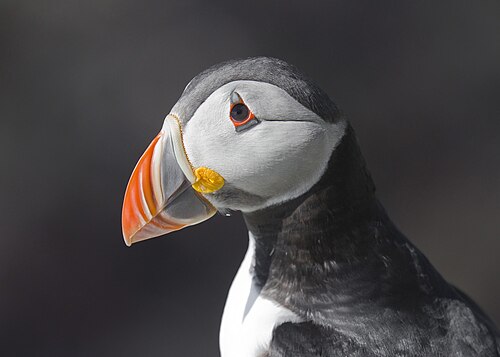
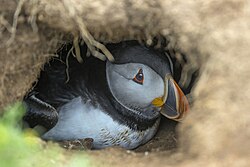
Picture credit: Andreas Trepte (CC BY-SA 2.5) · Charles J. Sharp (CC BY-SA 4.0) · Wikimedia Commons
Where does the atlantic puffin live?
Home: Cliffs and islands around the North Atlantic Ocean.
In the wild you find it in: Iceland, Norway, United Kingdom, Ireland, Faroe Islands.
Conservation status from the IUCN: vulnerable.
The short profile
Fully grown it measures 28–34 cm long, wingspan about 55 cm. It weighs about 0.5 kilograms. On the menu: meat.
The story behind it
Puffins spend most of the year far out at sea, only coming to land in spring and summer to breed on cliffs and islands, where they dig burrows up to a metre deep with their feet and beak. Their beak grows a bright orange, yellow and blue outer layer only during the breeding season and sheds it afterwards, turning duller for winter at sea. Underwater, puffins are surprisingly agile, using their short wings to 'fly' through the water while chasing fish, and can dive more than 60 metres deep. A single puffin can carry ten or more small fish crosswise in its beak at once thanks to backward-pointing spines on its tongue and palate. Climate change and overfishing of the small fish puffins rely on have caused declines, making the species vulnerable.
Find it on the globe
Atlantic puffin is there as a tiny animated figure that breathes and looks around. From far away the planet is only a blue ball; detail arrives as you zoom in, and this one appears once you are close enough. Open it on the globe.
It sits at its real coordinates, not near them — the same numbers listed in the facts above. Switch off the layer for this kind of place and it disappears again; the buttons for that are down the right-hand edge.
Questions children ask
How deep can a puffin dive?
Atlantic puffins can dive more than 60 metres underwater, using their short wings to swim after small fish almost like they are flying through the water. Most dives, though, last less than a minute.
Why is a puffin's beak so colourful?
A puffin's beak grows a bright outer layer of orange, yellow and blue plates only during the breeding season, likely to attract a mate. Once breeding ends, this colourful layer is shed and the beak turns duller.
Why are Atlantic puffins vulnerable?
Atlantic puffins are listed as vulnerable because warming seas and overfishing have reduced the small fish, like sand eels, that puffins need to feed their chicks. Some colonies have shrunk sharply as a result.
Where these numbers come from
Every figure on this page was checked against public reference sources before publication. Where sources genuinely disagree, the text says so.
Last checked: