Animal · United States, Mexico
Western diamondback rattlesnake
Crotalus atrox — the name this animal has in the language scientists everywhere share.
The western diamondback rattlesnake is one of the most common and dangerous rattlesnakes in North America, named for the diamond pattern along its back. It lives in deserts and scrubland.
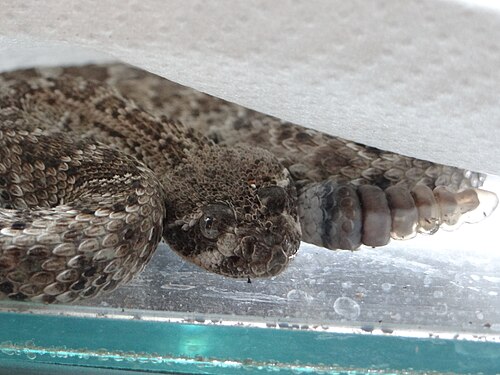
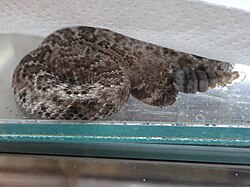
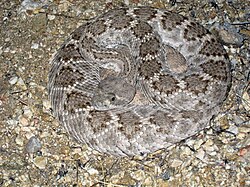
Picture credit: Eveha (CC BY-SA 3.0) · Eveha (CC BY-SA 3.0) · Michael Wifall (CC BY-SA 2.0) · Wikimedia Commons
Where does the western diamondback rattlesnake live?
Home: Deserts and scrubland of the southwestern United States and Mexico.
In the wild you find it in: United States, Mexico.
Conservation status from the IUCN: not in danger.
The short profile
Fully grown it measures About 1.2 m long. It weighs about 2 kilograms. On the menu: meat.
The story behind it
A rattlesnake's famous rattle is made of loosely connected, hollow segments of keratin at the tip of its tail, which knock together to make a buzzing warning sound when the snake shakes its tail, and a new segment is added each time it sheds its skin. Western diamondbacks hunt mainly at dawn, dusk and night, using heat-sensing pits on their face to detect the warm bodies of mice and rabbits even in total darkness, then striking with venomous fangs that fold flat against the roof of the mouth when not in use. Despite their fearsome reputation, rattlesnakes usually try to avoid humans and rattle as a warning rather than attacking first. They can go for weeks without eating after a large meal and play an important role controlling rodent populations in their desert habitat.
Find it on the globe
Western diamondback rattlesnake is there as a tiny animated figure that breathes and looks around. From far away the planet is only a blue ball; detail arrives as you zoom in, and this one appears once you are close enough. Open it on the globe.
It sits at its real coordinates, not near them — the same numbers listed in the facts above. Switch off the layer for this kind of place and it disappears again; the buttons for that are down the right-hand edge.
Questions children ask
What is a rattlesnake's rattle made of?
A rattlesnake's rattle is made of hollow, loosely linked segments of keratin, the same material as human fingernails. A new segment is added every time the snake sheds its skin, and shaking them makes the warning buzz.
How do rattlesnakes find prey in the dark?
Western diamondback rattlesnakes have special heat-sensing pits on their face that detect the warmth of nearby animals, letting them hunt mice and rabbits accurately even in complete darkness.
Do rattlesnakes attack without warning?
Usually not. Rattlesnakes typically shake their rattle as a warning to scare off a threat before biting, preferring to avoid a confrontation entirely if given the chance to escape.
Where these numbers come from
Every figure on this page was checked against public reference sources before publication. Where sources genuinely disagree, the text says so.
Last checked: