Animal · Germany, France, United Kingdom
Red fox
Vulpes vulpes — the name this animal has in the language scientists everywhere share.
The red fox is the most widespread wild carnivore in the world, living everywhere from forests and farmland to busy city streets. Its bushy tail and pointed ears make it instantly recognisable.
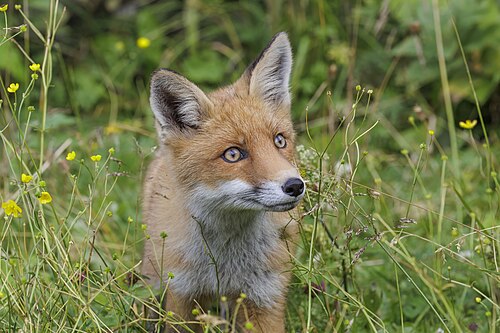
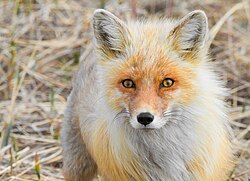
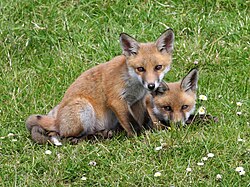
Picture credit: Charles J. Sharp (CC BY-SA 4.0) · Gregory "Slobirdr" Smith (CC BY-SA 2.0) · Ken Billington (CC BY-SA 3.0) · Wikimedia Commons
Where does the red fox live?
Home: Forests, farmland and even cities across the Northern Hemisphere and Australia.
In the wild you find it in: Germany, France, United Kingdom, United States, Canada, China, Russia, Australia.
Conservation status from the IUCN: not in danger.
The short profile
Fully grown it measures up to 90 cm long, plus a 45 cm tail. It weighs about 6 kilograms. On the menu: both plants and meat.
The story behind it
A red fox's hearing is so sharp it can hear a mouse squeak or scratch under nearly a metre of snow, which is how it performs its famous mousing pounce, leaping high and diving nose-first into snowdrifts. Foxes are clever and adaptable, happily eating fruit, insects, small mammals and even leftovers from bins in towns and cities. Their bushy tail, called a brush, helps with balance and wraps around the body like a blanket for warmth while sleeping. Because they can survive on almost any kind of food and habitat, red foxes are thriving even as many other wild animals struggle.
Find it on the globe
Red fox is there as a tiny animated figure that breathes and looks around. From far away the planet is only a blue ball; detail arrives as you zoom in, and this one appears once you are close enough. Open it on the globe.
It sits at its real coordinates, not near them — the same numbers listed in the facts above. Switch off the layer for this kind of place and it disappears again; the buttons for that are down the right-hand edge.
Questions children ask
Why do foxes jump into snow?
Foxes perform a high pounce, diving nose-first into snow, because they can hear small rodents moving beneath the surface and use this leap to pin their prey precisely. It is called mousing.
Do foxes live in cities?
Yes, red foxes have adapted very well to city life and can be found in parks, gardens and even under sheds, feeding on scraps as well as natural prey. They are most active at dawn, dusk and night to avoid people.
Are red foxes endangered?
No, red foxes are classed as least concern and are actually one of the most successful wild carnivores, found on more continents than almost any other mammal. Their adaptable diet and behaviour keep their numbers healthy.
Where these numbers come from
Every figure on this page was checked against public reference sources before publication. Where sources genuinely disagree, the text says so.
Last checked: