Animal · Australia
Tasmanian devil
Sarcophilus harrisii — the name this animal has in the language scientists everywhere share.
The Tasmanian devil is the world's largest carnivorous marsupial, now found only on the island of Tasmania. It is known for its bone-crushing bite and loud, screeching calls at night.
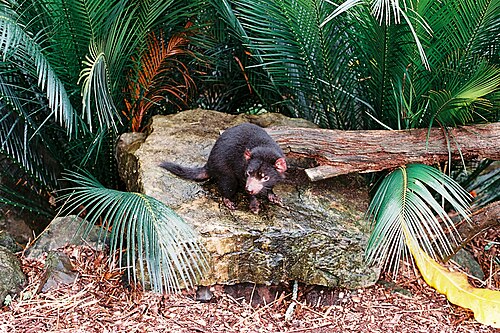
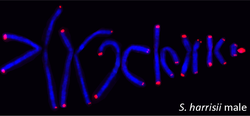
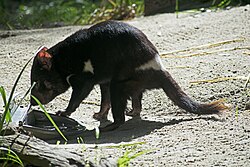
Picture credit: Sleeps-Darkly (CC BY-SA 4.0) · Hannah S. Bender , Elizabeth P. Murchison, Hilda A. Pickett, Janine E. Deakin, M (CC BY 2.5) · Ymblanter (CC BY-SA 4.0) · Wikimedia Commons
Where does the tasmanian devil live?
Home: Forests and coastal scrub of Tasmania, Australia.
In the wild you find it in: Australia.
Conservation status from the IUCN: endangered.
The short profile
Fully grown it measures up to 65 cm long, plus a 25 cm tail. It weighs about 8 kilograms. On the menu: meat.
The story behind it
Despite its small size, a Tasmanian devil has one of the strongest bites of any living mammal for its body weight, powerful enough to crunch through bone, fur and all when scavenging a carcass. Its terrifying screeches, growls and yawns are actually mostly bluff, used to scare off other devils at a shared meal rather than to attack. Devils are mainly scavengers, cleaning up dead animals in the forest, which is an important job for the ecosystem. Since the 1990s, a rare contagious facial tumour disease has spread between devils and wiped out much of the population, making the species endangered and the focus of major conservation breeding programmes.
Find it on the globe
Tasmanian devil is there as a tiny animated figure that breathes and looks around. From far away the planet is only a blue ball; detail arrives as you zoom in, and this one appears once you are close enough. Open it on the globe.
It sits at its real coordinates, not near them — the same numbers listed in the facts above. Switch off the layer for this kind of place and it disappears again; the buttons for that are down the right-hand edge.
Questions children ask
Why is it called a devil?
Early European settlers named it the devil because of its terrifying screeches, growls and dark fur, which sounded frightening at night. Its behaviour is actually mostly defensive bluff, not true aggression toward humans.
Why are Tasmanian devils endangered?
Tasmanian devils are endangered mainly because of a contagious facial tumour disease that spreads when devils bite each other, which has killed a large share of the wild population since the 1990s. Breeding programmes now protect healthy, disease-free groups.
What do Tasmanian devils eat?
Tasmanian devils mostly scavenge dead animals, eating almost every part of a carcass including bones and fur, but they also hunt small live prey like birds and insects when they can. This scavenging keeps forests clean.
Where these numbers come from
Every figure on this page was checked against public reference sources before publication. Where sources genuinely disagree, the text says so.
Last checked: