Animal · Australia
Wombat
Vombatus ursinus — the name this animal has in the language scientists everywhere share.
The wombat is a sturdy, burrowing Australian marsupial with short legs and powerful claws for digging. It spends much of the day resting in long underground tunnel systems.
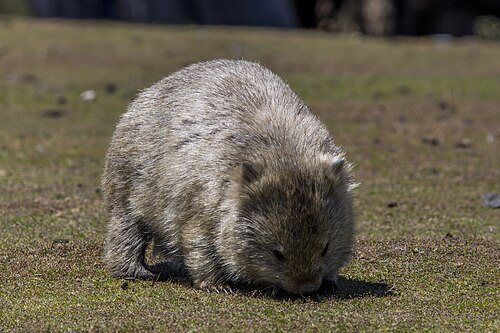
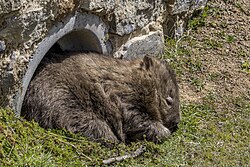
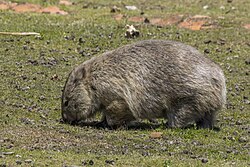
Picture credit: Charles J. Sharp (CC BY-SA 4.0) · Charles J. Sharp (CC BY-SA 4.0) · Charles J. Sharp (CC BY-SA 4.0) · Wikimedia Commons
Where does the wombat live?
Home: Forests, grasslands and mountains of southeastern Australia and Tasmania.
In the wild you find it in: Australia.
Conservation status from the IUCN: not in danger.
The short profile
Fully grown it measures up to 1 m long. It weighs about 26 kilograms. On the menu: plants.
The story behind it
A wombat is famous for producing cube-shaped poop, the only animal known to do so, which it stacks on rocks and logs to mark its territory without the droppings rolling away. Its burrows can stretch over 30 metres long with several rooms and exits, dug with strong front claws in just a few nights. When threatened, a wombat can defend itself using a tough cartilage plate on its rump to crush a predator's skull against the burrow wall. Wombats are mostly solitary and slow-moving but can sprint at up to 40 km/h in short bursts if truly startled. Wild wombat populations remain stable across their range today.
Find it on the globe
Wombat is there as a tiny animated figure that breathes and looks around. From far away the planet is only a blue ball; detail arrives as you zoom in, and this one appears once you are close enough. Open it on the globe.
It sits at its real coordinates, not near them — the same numbers listed in the facts above. Switch off the layer for this kind of place and it disappears again; the buttons for that are down the right-hand edge.
Questions children ask
Why does wombat poop look like cubes?
A wombat's intestine shapes droppings into cubes, likely so the pellets stay stacked on rocks and logs to mark territory rather than rolling away. It is the only animal known to produce cube-shaped poop.
How does a wombat defend itself?
A wombat has a tough cartilage plate on its rear end that it uses to block its burrow entrance and can even crush a predator's skull against the tunnel wall. This makes its backside a surprisingly effective shield.
How fast can a wombat run?
Despite looking slow and clumsy, a startled wombat can sprint at up to 40 km/h over short distances. It usually prefers a slow, waddling walk unless it needs to escape danger quickly.
Where these numbers come from
Every figure on this page was checked against public reference sources before publication. Where sources genuinely disagree, the text says so.
Last checked: