Animal · Zambia, Tanzania, Kenya
Hippopotamus
Hippopotamus amphibius — the name this animal has in the language scientists everywhere share.
The hippopotamus is a massive, barrel-shaped mammal that spends most of the day in African rivers and lakes to keep cool. At night it comes ashore to graze on grass.
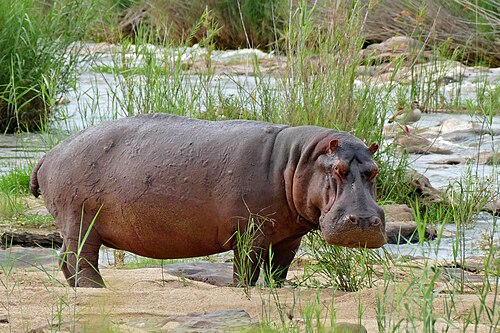
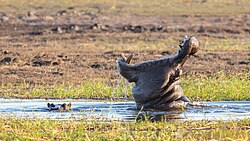
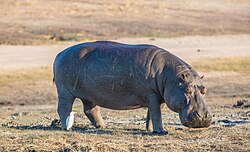
Picture credit: Bernard DUPONT (CC BY-SA 2.0) · Diego Delso (CC BY-SA 4.0) · Diego Delso (CC BY-SA 4.0) · Wikimedia Commons
Where does the hippopotamus live?
Home: Rivers and lakes across sub-Saharan Africa.
In the wild you find it in: Zambia, Tanzania, Kenya, Uganda, Mozambique, Zimbabwe, Botswana, South Africa.
Conservation status from the IUCN: vulnerable.
The short profile
Fully grown it measures up to 5 m long. It weighs about 1 500 kilograms. On the menu: plants.
The story behind it
Despite living in water, hippos cannot actually swim; instead they walk or bounce along the riverbed and can hold their breath for up to 5 minutes. Their skin produces a natural reddish oily sunscreen, sometimes called 'blood sweat', that protects it from sunburn and infection. Hippos look slow and gentle, but they are considered one of the most dangerous large animals in Africa, capable of running faster than a human on land and fiercely defending their territory in water. Each night, a single hippo can travel several kilometres inland to graze on grass. Habitat loss and hunting for meat and ivory-like teeth have made hippo numbers vulnerable.
Find it on the globe
Hippopotamus is there as a tiny animated figure that breathes and looks around. From far away the planet is only a blue ball; detail arrives as you zoom in, and this one appears once you are close enough. Open it on the globe.
It sits at its real coordinates, not near them — the same numbers listed in the facts above. Switch off the layer for this kind of place and it disappears again; the buttons for that are down the right-hand edge.
Questions children ask
Can hippos swim?
Hippos cannot truly swim or float; instead they walk, bounce, or run along the riverbed while mostly submerged. Their dense bodies sink easily, which actually helps them move underwater with control.
Are hippos dangerous?
Yes, hippos are considered among the most dangerous large animals in Africa because they are aggressive when defending territory and surprisingly fast, able to outrun a human on land over short distances.
Why is hippo skin reddish sometimes?
A hippo's skin produces a natural oily substance that turns reddish in the sun, often called 'blood sweat' even though it is not real blood or sweat. It acts as a sunscreen and helps fight infection.
Where these numbers come from
Every figure on this page was checked against public reference sources before publication. Where sources genuinely disagree, the text says so.
Last checked: