Animal · Kenya, Tanzania, South Africa
Ostrich
Struthio camelus — the name this animal has in the language scientists everywhere share.
The ostrich is the largest and heaviest living bird, standing up to 2.8 metres tall on the African savannah. It cannot fly, but it can outrun almost any predator on land.
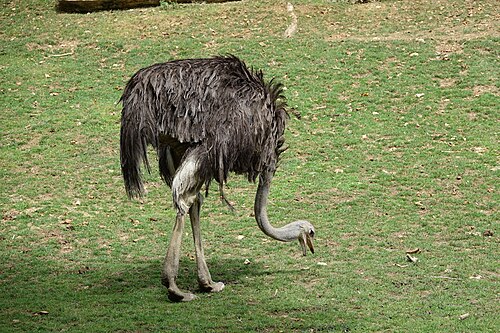
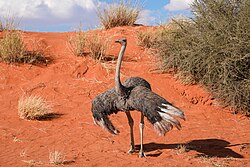
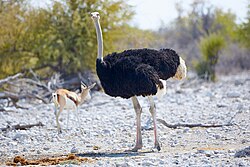
Picture credit: Gzen92 (CC BY-SA 4.0) · Giles Laurent (CC BY-SA 4.0) · Axel Tschentscher (CC BY-SA 4.0) · Wikimedia Commons
Where does the ostrich live?
Home: Open savannah and desert in Africa.
In the wild you find it in: Kenya, Tanzania, South Africa, Namibia, Ethiopia.
Conservation status from the IUCN: not in danger.
The short profile
Fully grown it measures 2.1–2.8 m tall. It weighs about 104 kilograms. On the menu: both plants and meat.
The story behind it
Ostriches cannot fly, but their long, powerful legs make up for it: they can sprint at over 70 km/h and keep up a steady 50 km/h for long distances, using their wings for balance as they turn sharply. A single kick from an ostrich is strong enough to injure or kill a lion, so most predators avoid a healthy adult. Ostriches lay the largest eggs of any bird, weighing around 1.5 kg, and several females often lay eggs in one shared nest that the dominant pair guards and incubates together. Despite their size, ostriches eat mostly plants, seeds and insects, and swallow small stones to help grind up tough food in their stomach.
Find it on the globe
Ostrich is there as a tiny animated figure that breathes and looks around. From far away the planet is only a blue ball; detail arrives as you zoom in, and this one appears once you are close enough. Open it on the globe.
It sits at its real coordinates, not near them — the same numbers listed in the facts above. Switch off the layer for this kind of place and it disappears again; the buttons for that are down the right-hand edge.
Questions children ask
Can ostriches fly?
No, ostriches cannot fly because their bodies are too heavy and their wings too small for lift-off. Instead, they use their long, strong legs to run at speeds of over 70 km/h to escape danger.
Do ostriches really bury their heads in the sand?
No, this is a myth. Ostriches lower their heads to the ground to turn their eggs in a shallow nest, which from a distance can look like burying their head, but they never actually bury it in sand.
How big are ostrich eggs?
An ostrich egg weighs around 1.5 kg, making it the largest egg laid by any living bird, even though it is small compared to the ostrich's own huge body size. One egg is equivalent to about two dozen chicken eggs.
Where these numbers come from
Every figure on this page was checked against public reference sources before publication. Where sources genuinely disagree, the text says so.
Last checked: