Animal · Mexico
Axolotl
Ambystoma mexicanum — the name this animal has in the language scientists everywhere share.
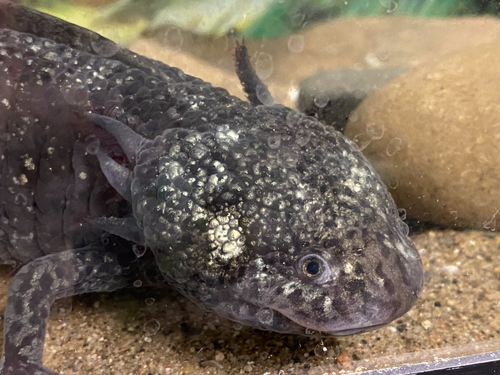
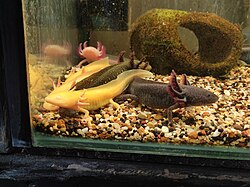
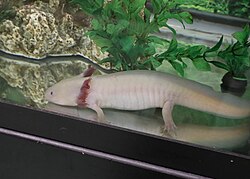
The axolotl is a strange salamander that never grows up, keeping its feathery gills and living underwater for its whole life. It survives in only one place: the canals of Xochimilco, Mexico.
Picture credit: Zhagen2024 (CC BY-SA 4.0) · Amrithraj (CC BY-SA 4.0) · Peter Cooper Jr. (CC0) · Wikimedia Commons
Where does the axolotl live?
Home: The canals and lakes of Xochimilco, near Mexico City.
In the wild you find it in: Mexico.
Conservation status from the IUCN: critically endangered.
The short profile
Fully grown it measures 23–30 cm long. It weighs about 0.15 kilograms. On the menu: meat.
The story behind it
Unlike most amphibians, an axolotl almost never undergoes full metamorphosis into a land-dwelling adult; instead, it keeps its external feathery gills and stays fully aquatic its entire life, a rare trait called neoteny. Its most astonishing ability is regeneration: an axolotl can regrow an entire lost limb, complete with bones, muscles and nerves, within a few weeks, and can even regenerate parts of its heart, spinal cord and even portions of its brain without scarring, making it one of the most studied animals in medical research. In the wild, axolotls hunt small fish, worms and insects on the muddy canal floor using a powerful suction bite. Sadly, pollution, invasive fish species and the shrinking of Xochimilco's waterways have pushed wild axolotls to the very edge of extinction, and the species is now critically endangered, even though it remains common as a pet.
Find it on the globe
Axolotl is there as a tiny animated figure that breathes and looks around. From far away the planet is only a blue ball; detail arrives as you zoom in, and this one appears once you are close enough. Open it on the globe.
It sits at its real coordinates, not near them — the same numbers listed in the facts above. Switch off the layer for this kind of place and it disappears again; the buttons for that are down the right-hand edge.
Questions children ask
Why is the axolotl famous with scientists?
Axolotls can regrow lost body parts, including whole limbs, parts of the heart and spinal cord, without leaving any scars. Scientists study this remarkable regeneration closely, hoping to learn lessons that could help human medicine one day.
Do axolotls turn into a different animal as adults?
Almost never in the wild. Unlike most salamanders, axolotls usually keep their gills and stay underwater their whole life instead of transforming into a land-based adult, a rare trait called neoteny.
Why is the wild axolotl critically endangered?
Wild axolotls survive in only one place, the canals of Xochimilco near Mexico City, where pollution, invasive fish that eat their eggs, and shrinking waterways have caused their numbers to collapse dramatically in recent decades.
Where these numbers come from
Every figure on this page was checked against public reference sources before publication. Where sources genuinely disagree, the text says so.
Last checked: